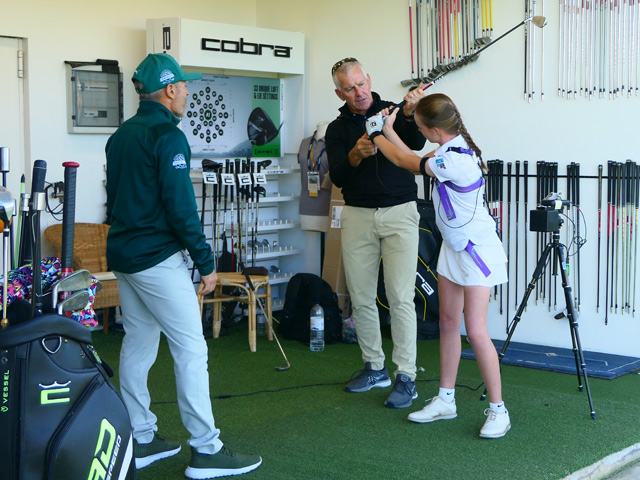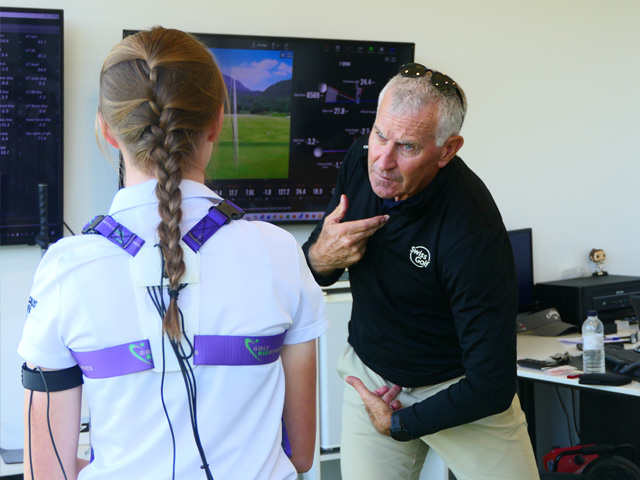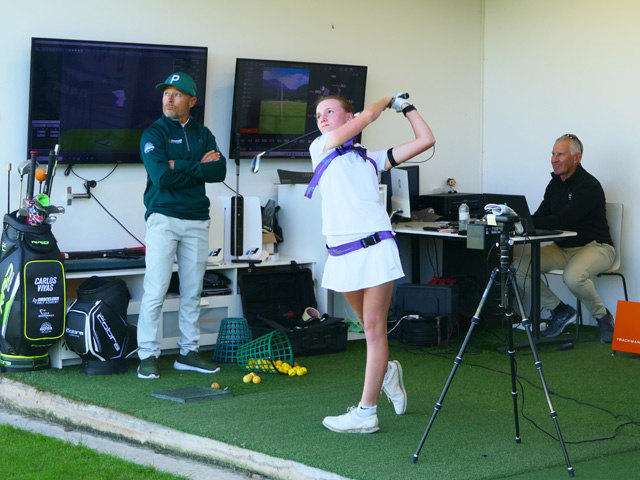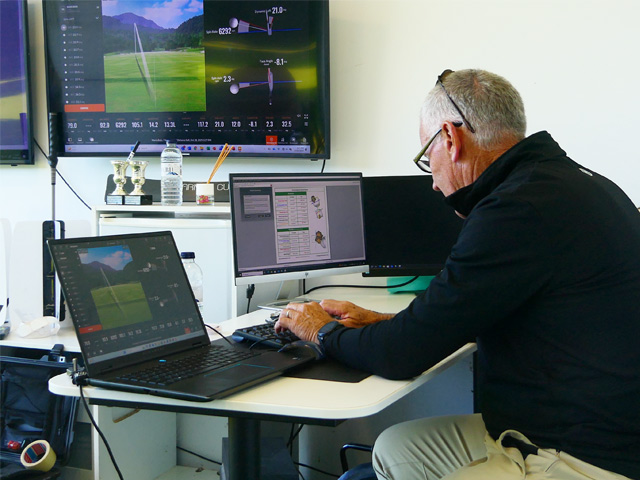
November 14, 2025 — Dr. Robert Neal, one of the world’s leading authorities in golf biomechanics and swing analysis, recently visited the Barcelona Golf Academy (BGA) at the Club de Golf Barcelona, where he worked closely with coaches and junior players on the advanced use of 3D Golf BioDynamics technology.
His presence reaffirmed the academy’s commitment to innovation, technical precision, and continuous improvement in high-performance golf instruction.
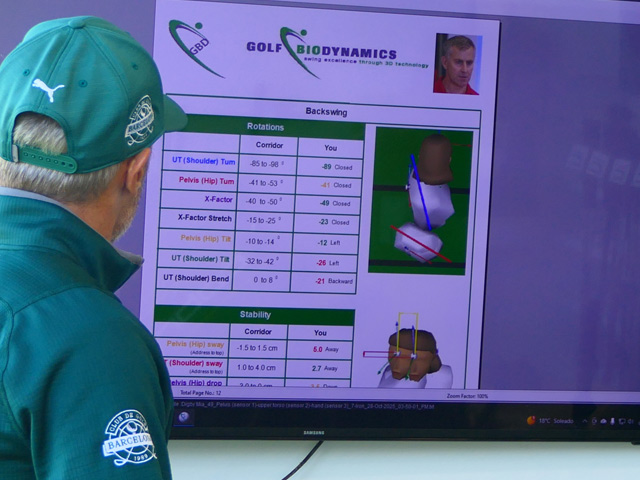
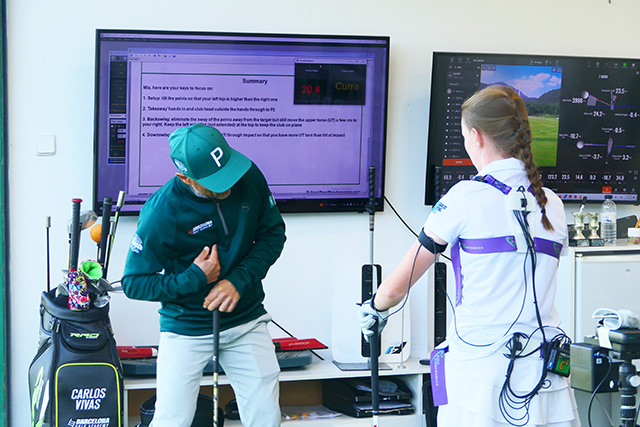
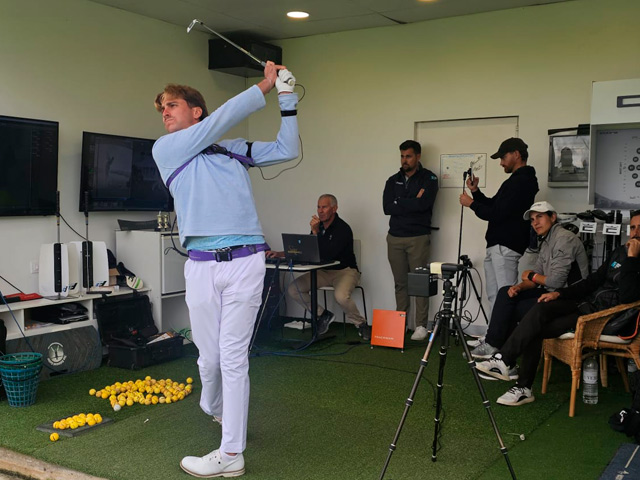
During his stay, from October 28 to 30, 2025, Dr. Neal delivered specialized training sessions for the academy’s technical team, both in the driving range box and on the putting green, focusing on the biomechanical interpretation of the swing and the practical application of 3D technology for all types of shots.
These sessions represented a valuable opportunity to strengthen BGA’s working methodology and to raise the technical knowledge level of its coaching staff.
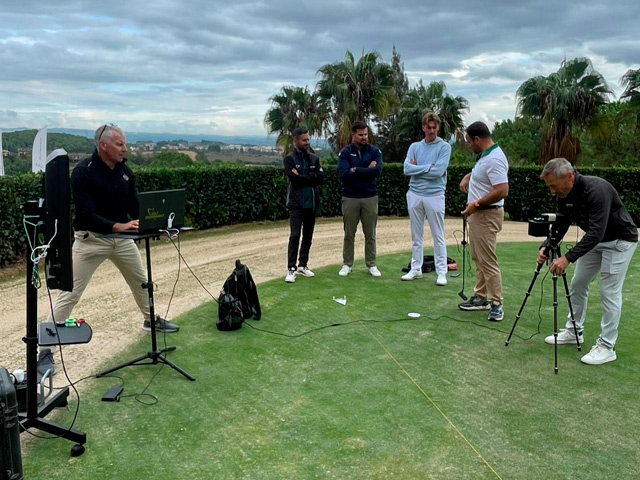
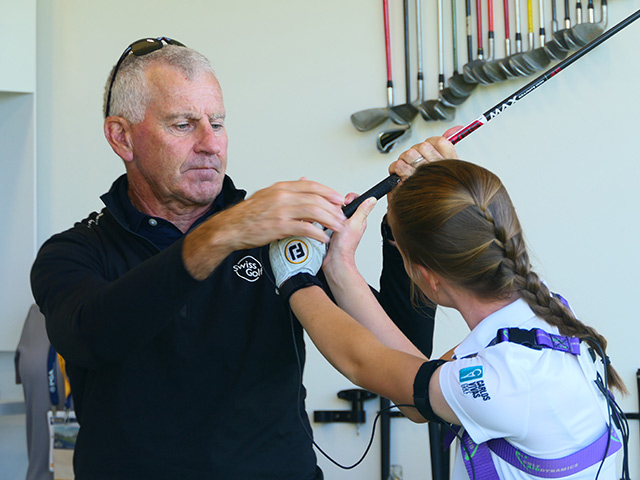
In the afternoons, accompanied by Head Coach, Carlos Vivas, Dr. Neal carried out detailed, individualized swing analyses for players in the Elite Junior Program, providing each with a personalized diagnosis and training plan.
His visit not only helped assess the progress of young talents but also inspired a new stage of technical and motivational development within the academy. In this interview, Dr. Neal shares his vision of modern golf instruction, the importance of fundamentals, and the future of biomechanics in the game.
MYGOLFWAY: Golf is a very complex game, and when you come to Barcelona, a bit of a revolution happens. The coaches and juniors at the academy all want you to make their “swing radiography,” as if you brought a magic elixir or had discovered the secret of the perfect swing. But in fact, how do you see yourself?
Dr. ROBERT NEAL: When I come here to work with Carlos and his team of coaches at the Barcelona Golf Academy, my duty is to help them identify the issues in the students’ swings and also reinforce for them how important it is to pay attention to the little fundamental things that make a golf swing truly effective.
I spend time working with the players, identifying areas for improvement, but I also emphasize to the coaches that they must watch those details and ensure that the practice is done properly — otherwise, the players won’t get better.
MYGOLFWAY: There are several advanced swing analysis systems today. Why would you recommend your 3D Golf BioDynamics system over others?
Dr. ROBERT NEAL: There are many reasons why I like the electromagnetic Golf BioDynamics systems. First, it’s portable, so I can travel with them. Second, they’re quick to set up, very accurate, and perhaps the best thing for coaching is the real-time audio feedback. So, I can set corridors of movement possibilities, and then the player can work with the coach and find out what it feels like to move correctly.
The tone helps them realize that even if a movement feels awful, but I know it’s correct, I’m moving the right way.That’s really valuable compared to other systems that don’t offer real-time feedback.
MYGOLFWAY: Analysis systems can be more or less professional, sophisticated or promoted, but I think success depends mostly on the people, on their knowledge, and on the quality of their human relationship with the players. Do you agree?
Dr. ROBERT NEAL: Yes, definitely. There are more and more systems becoming available, many using AI and cameras. Some are accurate, others less so. But even with the most accurate systems, the real value lies in the coach’s knowledge — their understanding of 3D biomechanics and then how to use that information in developing or building a golf swing. If you don’t have that knowledge, the information you get from a 3D system is almost worthless.
MYGOLFWAY: Do you think junior players should go through the 3D Golf BioDynamics analysis once or twice a year? Why?
Dr. ROBERT NEAL: At least twice a year. Why? Because it allows them to know what to work on, work on it, and then check their progress. It’s a continuous evaluation process: analyze, train, and review. If you can use the system for real-time feedback, even better — so that you don’t have backward steps in the learning process and helps ensure constant progress. Golf is hard enough already; going backwards only makes it more frustrating.
MYGOLFWAY: Motivation and progress are essential for teenagers to stay engaged. Have you introduced anything new or special for juniors?
Dr. ROBERT NEAL: The software doesn’t have a specific junior version, but the key lies in how the coach would use the information to motivate them. You can “gamify” the learning process a little bit to make it more engaging.
You can get them to really focus in on particular aspects of the swing, and when juniors see progress, they get more involved, then they really engage and embrace the system so that they want to keep doing that. It’s a little bit addictive that way. If they notice improvement, they want to keep going.
Also, receiving accurate feedback gives them confidence: they know the coach isn’t just saying, “Good, that looks better,” but that they can verify it with real data. Measuring and quantifying progress is very powerful.
MYGOLFWAY: How have you seen the Barcelona Golf Academy this year? Are the juniors motivated?
Dr. ROBERT NEAL: Yes, Carlos and his team have created an excellent environment for the juniors. They’re good kids, and they work hard. There’s always room for improvement, and Carlos is constantly looking for ways to move forward. I’ve given him a few suggestions to put into practice.
MYGOLFWAY: What’s next for you in golf technology?
Dr. ROBERT NEAL: I’m continuing to develop the electromagnetic system software because I believe it has enormous value for coaching. But I’m also involved in a markerless, camera-based system, very accurate, called ELVA Golf, developed with a team from Iceland. We’ve been working on it for about 18 months. We presented it at the PGA Show in Orlando this year, and we’ll return next year with a much-improved version.
The big difference is that it’s not portable — it’s designed for studio type scenario with fixed cameras, no cables, sensors, or markers. It’s very convenient, though it doesn’t provide real-time feedback. Every system has its strengths and weaknesses.
MYGOLFWAY: Final question: Then, will you have time for all of this development?
Dr. ROBERT NEAL: Yeah, I hope so. If I go to the PGA Show in Orlando, I’m sure many clubs will be interested. And yes, I’ll need to build a team. Exactly.
Thank you very much for your time, Dr Robert.