
Drivers
Ping – Discovering the origin of the new G30 driver Turbulator Technology
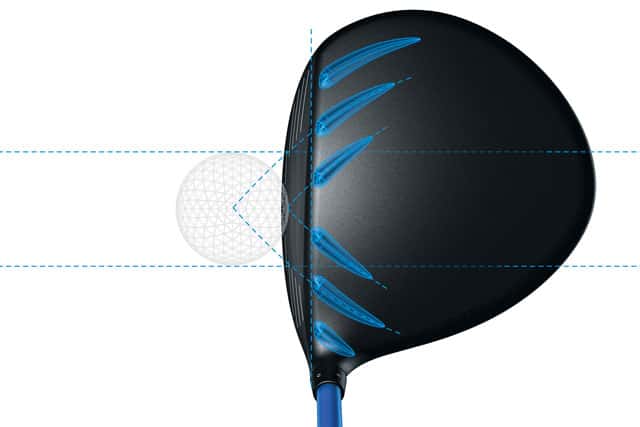
July 15, 2014 – The launch of the Ping G30 driver has been tremendous. The immediate victory of Angel Cabrera at the first PGA Tour event in which it was played has pushed up the credibility of the innovative Turbulator Technology included in its crown. So we find ourselves asking… how it has been developed and how does it work?
Last week we had the chance to attend an exclusive presentation of the G30, invited by Ping Spain to the European headquarters of the company at Gainsborough (Lincolnshire, United Kingdom). So we know from a good source that players like Bubba Watson, Miguel Angel Jimenez, Louis Oosthuizen, Lee Westwood, Alejandro Cañizares, Azahara Muñoz… and many other members of the Ping staff are already testing it, and the feedback is really good. While we amateurs expect to see the driver soon in golf stores, we’ll be watching the players using it this week at The Open Championship and looking at its performance.
By the way, for those who are rather impatient, all new G30 Series will be on sale worldwide on 31st of July exclusively through Ping Fitting centres, and will be generally availability in mid-August.

While waiting for that moment, these are some of the best-kept secrets around the G30 driver, and the origin of Turbulator Technology.

In a survey on golfers conducted by Golf Datatech in summer 2013 regarding the most valued aspects of a driver, 96% cited ‘help to hit more fairways’, 74% ‘help them correct their biggest mistakes’ and 64% ‘help to hit further’. So the main goal for Ping engineers is to provide greater clubhead speed, but without sacrificing the virtues already offered in the G25.
Starting from the basis of the applications in airplanes and Formula 1, Marty Jertson, Ping senior design engineer, worked on the idea at Sheffield University thinking up a way of giving the clubhead a few spoilers that would serve to reduce aerodynamic drag by significantly delaying the airflow separation. Then the concept was transferred to Dr. Paul Wood, Ping Director of Innovation at Phoenix (USA), for development at Arizona State University.
Testing was carried out with multiple turbulators at different heights, in bigger or smaller quantities, and in several orientations, and the wind tunnel was used to determine the best aerodynamics, all of which lead to the conclusion of the current design.
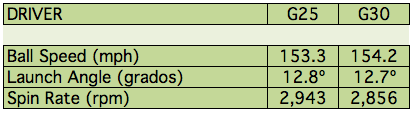
Up to 3mph more clubhead speed has been achieved with the Turbulator Technology, with a +0.7 mph average over the G25, without sacrificing other properties such as control and forgiveness. Translating this into shot parameters (for the two clubs fitted to the same specifications) without sacrifice:

The sole architecture doesn’t have turbulators as, so they say, they don’t fit in the address. But it does have a thinner wall, and some reliefs that produce a deeper sound and more power.
Angel Cabrera has won in drive distance and drive accuracy. This is something that the majority of amateurs can very probably enjoy with one of its two versions, either with the standard G30 driver or with the G30 SF Tec, where the weight towards the heel helps strike straighter hits for those players who tend to ere to the right of the target.
Por REDACCIÓN

