
Drivers
Review: TaylorMade Golf SLDR Driver

October 8, 2013 – The first time I saw pictures of it on the Internet I thought it looked somewhat unrefined. Having got used to the discretion of the Speed Pocket in the fairway woods and hybrids, which gets to be minim alist in the new SpeedBlade irons, the rail of the sole of the new star of TaylorMade Golf, the SLDR driver, looks rather disproportionate. On top of that, with the launching of the R1 and RBZ Stage 2 drivers earlier this year, isn’t it a bit soon to present yet another one?
Well, that said, considering the catchphrase claiming “longest TaylorMade driver ever”, and coming from the world #1 driver brand in the market, we just have to give it the red carpet up to the 1st tee.
Introduced in late July and active on Tour since August, we saw the SLDR in the hands of Sergio Garcia and thought the Spanish player was going to be the first to give it its first victory when he was about to win the Deutsche Bank Championship in early September. Almost, but not quite! The player who won that tournament was Henrik Stenson, wielding a TaylorMade R1 (9th, Grafalloy Blue X shaft). What happened after that to make the Swedish golfer, who was on a good run playing superbly and with total concentration, change his driver in a question of a week and win again, no less than the Tour Championship and the FedExCup? Yes, he is the best on the Green in Regulation stats, but this time he won with the TaylorMade SLDR driver (10.5 °, Grafalloy Blue X shaft) in his golf bag.

At last, two SLDR models have fallen into our hands, one standard and one TP, with which our prejudices have faded. The golf club itself is elegant, with an excellently manufactured mechanism, clean and well finished, (you can’t expect anything else coming from TaylorMade Golf) and has not been retouched between its launching and its arrival at the golf stores, despite the rush to get it into the market as soon as possible to avoid imitation from other brands.
No, it isn’t white, but it is aesthetically very attractive thanks to its shape, colour and visual details. The shape looks modern but classic, the charcoal-grey crown and chrome button-back makes it handsome and reliable at address.
The secret of the blue sliding weight
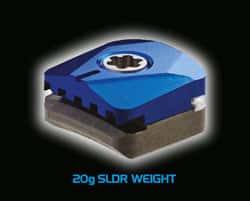 The SLDR driver is designed to hit longer and straighter drives, with a high launch angle, lower spin-rate and faster ball speed. The robot tester claims that it is the longest in TaylorMade’s history, based on tests with drivers with 9.5°, in neutral settings, and a ball speed of some 240 km/h. And it does it by placing the centre of gravity lower and further forward, largely thanks to the sliding blue weight of 20g in the sole, which is what promotes a dramatic leap in distance.
The sliding weight of the SLDR represents a complete reinvention of the movable weights of previous technology (MWT), replacing the two interchangeable screws fitted to the two ports on heel and toe, and is now more effective and easier to use. You can loosen, slide and tighten the screw in less than 10 seconds. Sliding the blue piece horizontally towards the heel you favour the draw, while towards the toe you favour the fade. From side-to-side the trajectory changes up to 30 yards. The weight never comes off the clubhead, and moves along the 21 possible positions on the track. The sole usefully shows where to move it to Draw or Fade. It makes it very clear what you need to do to get the shape you want in your shots.
We’ve already spoken about the Loft-sleeve technology in the tip of the shaft of the SLDR in previous test (R1 and RBZ Stage 2) which allows you to adjust the loft in 12 positions, 1.5 ° up or down. This is good news as the SLDR comes with lofts of 9.5 °, 10.5 ° and HL (12º) as a starting point.
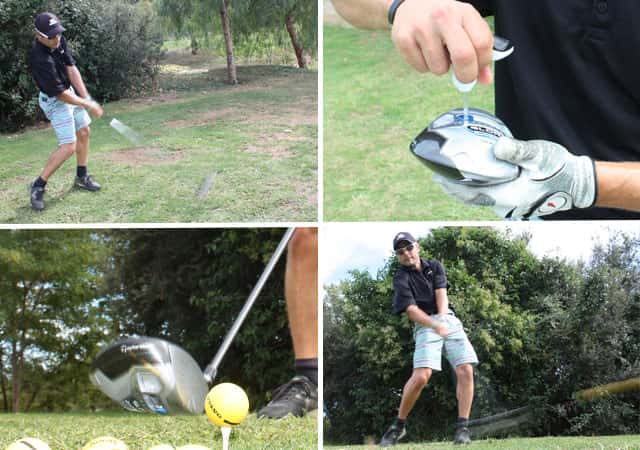
We met Carlos Vivas, professional at Club de Golf Sant Cugat (Barcelona, Spain) and head coach of the Junior Golf Academy, and we lent him the SLDR TP so that he could test it at the driving range. He hit half a bucket of golf balls with the standard configuration, which responded with a fantastic trajectory, straight and long, with no hint of exaggeration in the height. Then we moved the blue weight with the key to the full fade, and we finished by putting the weight fully on draw, to see how it changed the shots. These are his comments:
- What I like most is finding what I’m looking for in a driver. Already with the first three balls I hit, I like the feeling of the club.
- It is a really nice golf club. It reminds me of a classic club because of its grey anthracite colour.
- The truth is that it looks as if it’s going to go a long way, especially with the combination of the clubhead weight and the shaft, which is perfect for my swing. In the end, that’s what makes the ball go long or not. If it fits you well, it will certainly be long.
- I also like the track, which makes it quicker to add a little more draw or fade, depending on your tendency. In the test its clear that when you put the weight full on the draw it’s much easier to send a closed ball, and if you put it at the top of the Fade you get the opposite.
- Players go through phases in which they fail shots more that usual, or their tendency is more accentuated. With this club you can correct simply it by modifying the weight. And you can also adjust the loft. As in other sports which involve a machine that can be tuned, such as motorcycling or F1, here you have a club that adapts to your swing, to how you want to play the golf course, to weather conditions, and if you want to hit a little draw or you want the ball to go lower.
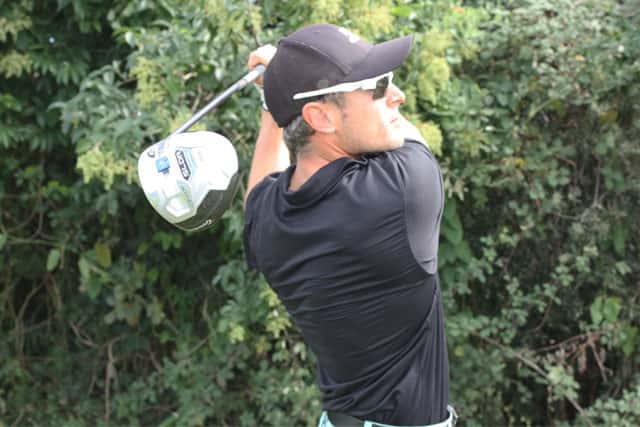
Then we offered the second driver, the standard SLDR (10.5°, Fujikura Speeder 57, flex R), to one of Carlos Vivas’ amateur pupils to test it on the driving range. Surprised by the improvement in his drives, Carlos weight-adjusted fully to fade to correct his tendency to pull, and the drives started coming out straighter than straight. Brilliant!
Well, we thought the R1 was the ultimate, but the SLDR is equally amazing, although different. We think the SLDR suits a wider range of golfers, and it will seduce many more average players who haven’t really got used to the R1. And certainly, with this new sliding weight system, players will be more likely to tune the driver more often, instead of configuring the different settings and leaving them fixed almost forever, which is what tends to happen in general.
TAYLORMADE GOLF SLDR DRIVER
- Club reviewed: 9.5° driver, standard loft, Fujikura Motore Speeder TP 67g shaft, flex S.
- Tester: Carlos Vivas (37). Pro at CG Sant Cugat (Barcelona, Spain).
DESIGN [rating: level=”5″] DISTANCE [rating: level=”5″] ACCURACY [rating: level=”5″] FORGIVENESS [rating: level=”5″] FEELING [rating: level=”5″] OPTIONS [rating: level=”5″] VALUE [rating: level=”4″] FOR… All players AVERAGE [rating: level=”5″]
With the SLDR all the balls have come off really well. Easy to move, light, balanced… An innovative driver that improves and accelerates the movable weight adjustment system, and allows you to draw and fade more easily, while helping to correct the hook and slice, and offering a guaranteed long distance.
Three new drivers by the same brand in the same season can be confusing for consumers, especially if they are not clear about their golfing profile. In times of economic crisis the price could be another objection. Apart from that, it’s fantastic.
Por REDACCIÓN
TECHNICAL FEATURES
Lofts: 9.5º, 10.5º, HL (12º). Lie: 59º-62º. Volume: 460cc. Shaft: Fujikura Speeder 57. Flex: X, S, R, M. Shaft length: 45,5”. Swingweight: D4. Grip: TM 360, 54g. Lefthanded: 9,5º, 10,5º. Custom shafts. Key factors: Movable weight reinvention. Lower Center of Gravity. SLDR weight technology. Aligment benefits. Loft tuneable with Loft-sleeve Technology. Models: SLDR, SLDR TP (Fujikura Motore Speeder TS 6.3 shaft, 45,25”, X, S, R), SLDR Ladies (10,5º, 12º, Fujikura Speeder 45 shaft, 44,5”, L, D1). RPP: SLDR, €449; SLDR TP, €529.


